

Overview
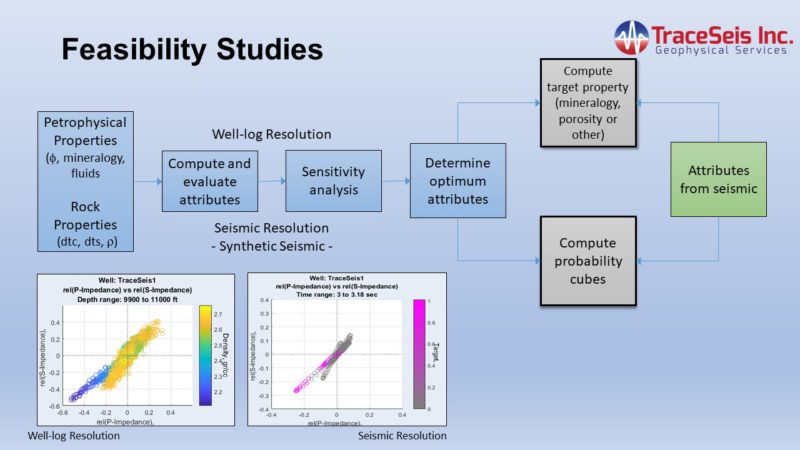
TraceSeis offers a robust solution for assessing reservoir and geomechanical properties by leveraging well-calibrated seismic data. Our comprehensive workflow is divided into four sequential stages that ensure reliable estimation of key properties such as porosity, lithology, and pore fluids. This process not only demonstrates the feasibility of the estimation but also lays the groundwork for detailed quantitative interpretation based on seismic attributes.
Stage 1: Rock Physics Analysis with SeisRP
Objective: Determine the viability of estimating reservoir properties using available rock data.In this initial stage, TraceSeis utilizes well-log data to estimate rock properties and seismic attributes at both well-log and seismic resolutions. By simulating different reservoir conditions—covering variations in porosity, lithology, and pore fluid characteristics—this phase answers a critical question: Do the physical properties of the rocks support the estimation of the reservoir properties of interest? Establishing this connection early in the workflow ensures subsequent stages are built on a solid foundation.
Stage 2: Seismic Data Fitness Evaluation and Conditioning
Objective: Ensure pre-stack seismic data accurately represents the offset-dependent reflectivity of the subsurface.For quantitative estimation of reservoir properties, it is essential that seismic data capture true subsurface responses. In Stage 2, TraceSeis conditions the pre-stack seismic data to meet this requirement. Key processes applied during this stage include:
- Amplitude Variation with Offset Calibration:
Using pre-stack synthetic seismograms generated in Stage 1 as a calibration reference. - Residual Multiples Attenuation:
Reducing multiple reflections that could distort the signal. - Residual Alignment of Events Across Offset:
Ensuring consistency in event timing across different offsets. - Random Noise Attenuation:
Enhancing signal quality by diminishing random noise. - Wavelet Phase and Amplitude Equalization:
Standardizing the seismic wavelet across offsets for a consistent analysis.
This conditioning ensures that the seismic data is as faithful a representation of the subsurface as possible.
Stage 3: Seismic Attributes’ Computation
Objective: Extract the optimum seismic attributes for reservoir/geomechanical interpretation.Based on the insights gained from Stage 1, the next step is to compute seismic attributes or relative rock properties that best represent the reservoir conditions. These attributes are derived following the data conditioning of Stage 2. By focusing on the previously determined optimum parameters, TraceSeis prepares a high-quality dataset that forms the basis for the final reservoir/geomechanical property estimation.
Stage 4: Computation of Reservoir/Geomechanical Properties
Objective: Convert seismic attributes into quantitative reservoir and geomechanical properties.In the final stage, reservoir and geomechanical properties are estimated as a linear combination of the computed seismic attributes. The workflow employs a regression-based approach where the coefficients of the linear combination are determined using synthetic and well-log data. This estimation is then applied to the real seismic dataset to produce property outputs that approximate the values measured by well-logs.Key highlights of Stage 4 include:
- Linear Regression Analysis:
The coefficients for the linear fit are estimated by applying least-squares fitting to well and synthetic data. - Quantitative Interpretation:
The properties derived from the seismic volume provide a reliable basis for interpretation, closely approximating the reservoir/geomechanical measures captured in well-log data. - Integrated Workflow:
The systematic computation process helps ensure that the final product is both robust and directly applicable for further exploration and geomechanical analysis.
Conclusion
TraceSeis employs a four-stage workflow to rigorously evaluate and compute reservoir and geomechanical properties from seismic data. By combining rock physics analysis, meticulous seismic data conditioning, optimized seismic attribute computation, and robust linear regression techniques, our approach ensures that the final estimates are both accurate and meaningful.This method not only streamlines the process by reducing user input and simplifying parameterization but also provides the quantitative insight essential for confident reservoir characterization and geomechanical modeling. Discover how this innovative strategy can transform your subsurface interpretations and guide more informed decision-making in exploration and production.